
APPLICATION WINDOWS
Stratalog - Windows 11 Edition
L’application de bureau Windows est actuellement en développement.
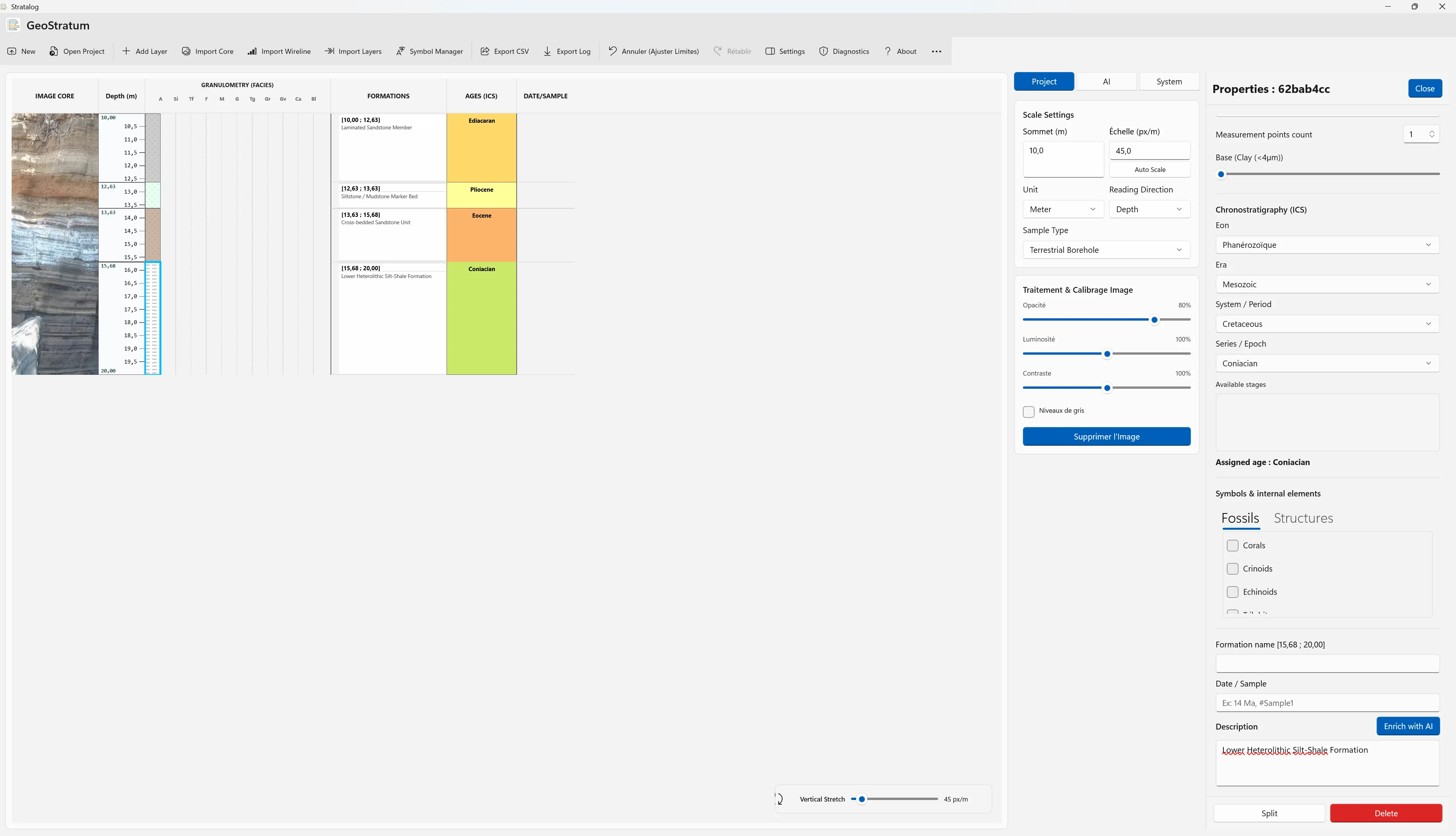
A modern and high-performance Windows desktop application designed to create, analyze and edit geological logs (stratigraphic columns). Built with native C# WinUI 3 and C++ backend.
Installation & Licensing
Run Installer
Téléchargez et installez l'application Stratalog directement depuis le Microsoft Store. Windows gère automatiquement l'installation et les dépendances de C# WinUI 3.
Application Architecture
1. Stratalog.App (C# WinUI 3)
Fluent Windows 11 desktop interface with GPU-accelerated rendering via Microsoft.Graphics.Win2D for high-performance vector display of stratigraphic data and geological symbols.
2. Stratalog.Core (C++ DLL)
Native computation engine for elevation calculations and lithology terminology database management, providing native speed and zero garbage collection overhead.
3. Local AI Engine
Bare-metal local execution of the Google Gemma-4 E2B Instruct model (vision + text): native AOT binaries (.bin Qualcomm QAIRT, .blob Intel OpenVINO NPU) and ultra-fast GGUF via LLamaSharp (discrete GPU/iGPU and CPU fallback). Total privacy, zero cloud.
Key Features
-
✔
Image Calibration Tool
Load core photographs, apply rotation and scaling, and set reference scale with visual feedback for automatic pixel-to-meter conversion.
-
✔
Vector Graphics Engine
Render geological layers with customizable erosion profiles and high-fidelity vector rock textures dynamically.
-
✔
Property Inspector
Edit detailed layer properties including grain size, chronostratigraphy (ICS 2024), fossils, and sedimentary structures.
-
✔
Custom Symbol Manager
Create or import geological symbols as SVG/PNG, automatically saved inside project files in Base64 format.
-
✔
Wireline Integration
Display geophysical curves from CSV/TXT files overlaid directly on your stratigraphic log charts.
-
✔
Multi-Language Support (14 Languages)
Fully translated into 14 languages with persistent preference settings: Allemand (Deutsch), Anglais (English), Arabe (العربية), Chinois (中文), Coréen (한국어), Espagnol (Español), Français, Indonésien (Bahasa Indonesia), Italien (Italiano), Japonais (日本語), Persan (فارسی), Portugais (Português), Russe (Русский), Turc (Türkçe).
System Requirements
| Component | Minimum Requirement | Recommended Specification |
|---|---|---|
| Operating System | Windows 10 (Build 19041+) | Windows 11 (22H2 or newer) |
| Processor (CPU) | Intel Core i7 (7th Gen) / AMD Ryzen 5 (2000) / Snapdragon 8cx Gen 3 (Min. 4 Coeurs, compatible x64 & ARM64) | Intel Core i7 (12e Gen) / AMD Ryzen 7 (5000) / Snapdragon X Plus (8 Coeurs conseillés, support natif x64 & ARM64) |
| System RAM | 4 GB RAM | 16 GB RAM or more |
| Graphics Card (GPU) | DirectX 12 compatible (Intel Iris Xe, AMD Radeon RX 500) | NVIDIA GTX 1660 / RTX 2060 / AMD RX 6000 series or dedicated GPU |
| Video Memory (VRAM) | 2 GB VRAM | 4 GB or more dedicated VRAM |
| NPU (Optional) | N/A | Windows Copilot+ PC compatible NPU (40 TOPS min) |
| Disk Space | 4 GB free SSD | 10 GB NVMe SSD space |
Local Multimodal AI Engine
L'inférence IA hors-ligne de Stratalog repose sur un modèle de base unique : Google Gemma-4 E2B Instruct (multimodal texte + vision). Afin d'exploiter chaque processeur au plus près du silicium sans latence JIT, le moteur applique 4 méthodes d'exécution matérielle spécialisées : binaires AOT .bin via Qualcomm QAIRT SDK sur NPU Snapdragon X/X2 (INT4/W4A16 ~1,12 Go), blobs précompilés .blob via Intel OpenVINO sur NPU Core Ultra 200/300 (INT4/W4A16 ~1,12 Go), déchargement GPU total en format GGUF Q4_0 Google QAT via LLamaSharp (NVIDIA RTX, AMD Radeon RDNA et Intel Arc ~3,19 Go), et fallback universel CPU en GGUF Q4_K_M (~2,96 Go). Zéro transmission vers des serveurs externes, zéro fichier safetensors lourd.